Cultivation and agronomy
The quality of a coffee is prepared in the field. Climate, altitude and rainfall already set much of what the cup can offer.
The essentials in three points
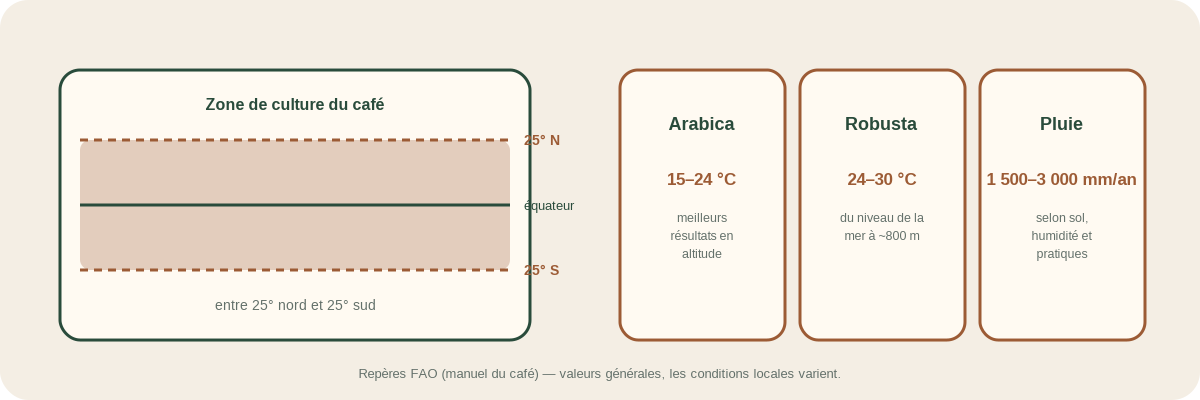
- Coffee is grown between 25° north and 25° south, with precise requirements depending on the species [1].
- Ideal average temperatures: 15–24 °C for Arabica, 24–30 °C for robusta [1].
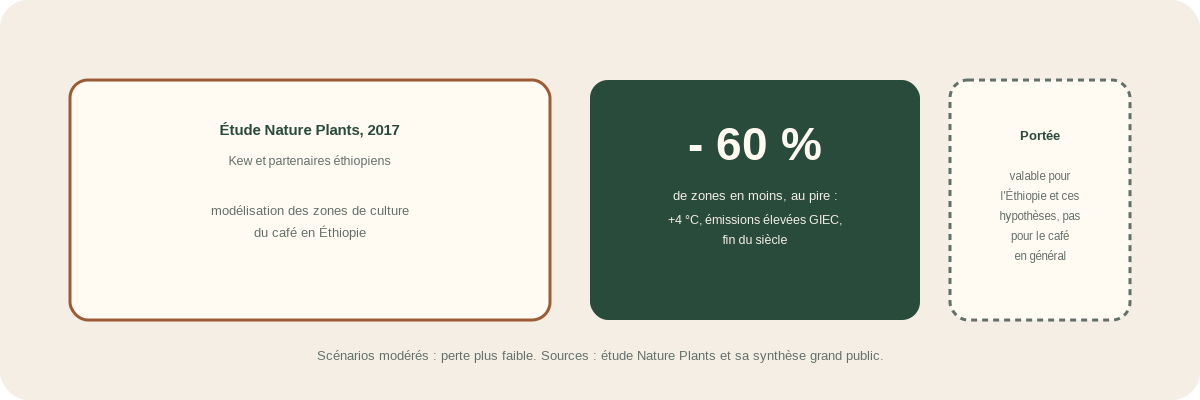
- 2017 study (Ethiopia): current growing areas could shrink by up to 60 % in the most pessimistic scenario (+4 °C by 2100); more moderate scenarios give smaller losses [2] [3].
Go deeper
Tap a heading to open or close the section.
Temperature and frost
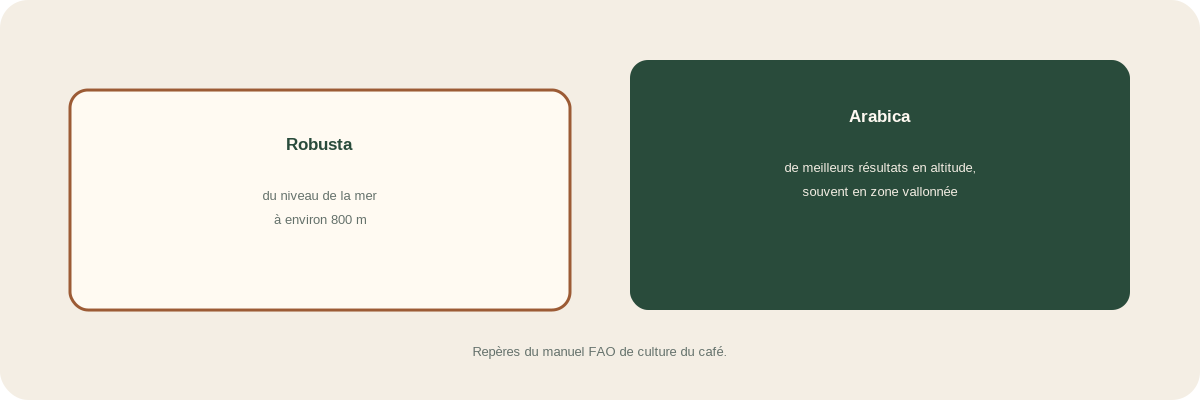
Altitude
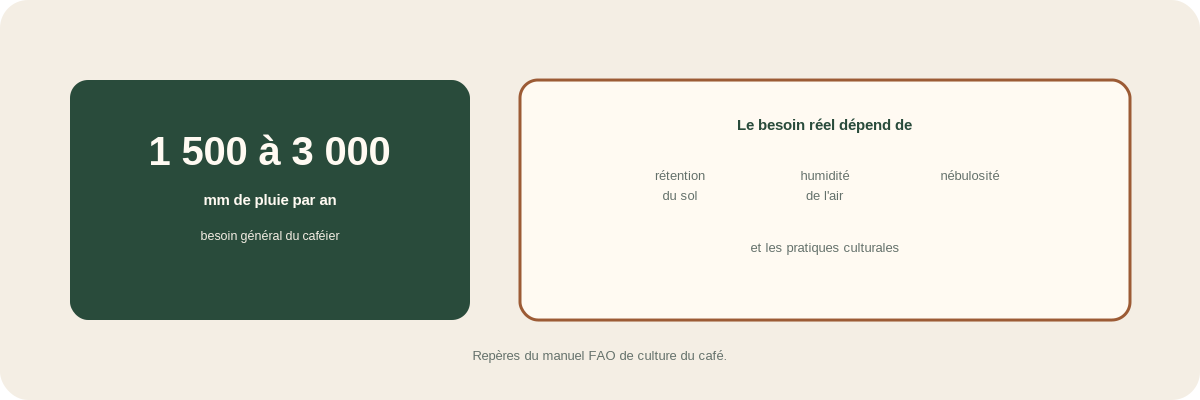
Rainfall
Climate change
A study published in 2017 (Nature Plants, Kew and Ethiopian partners) models Ethiopia: current coffee growing areas could shrink by up to 60 % for a 4 °C rise by the end of the century, a high-emissions IPCC scenario; with more moderate scenarios the loss is smaller. The result holds for Ethiopia and these assumptions, not for coffee in general [2] [3].
Shade and agroforestry
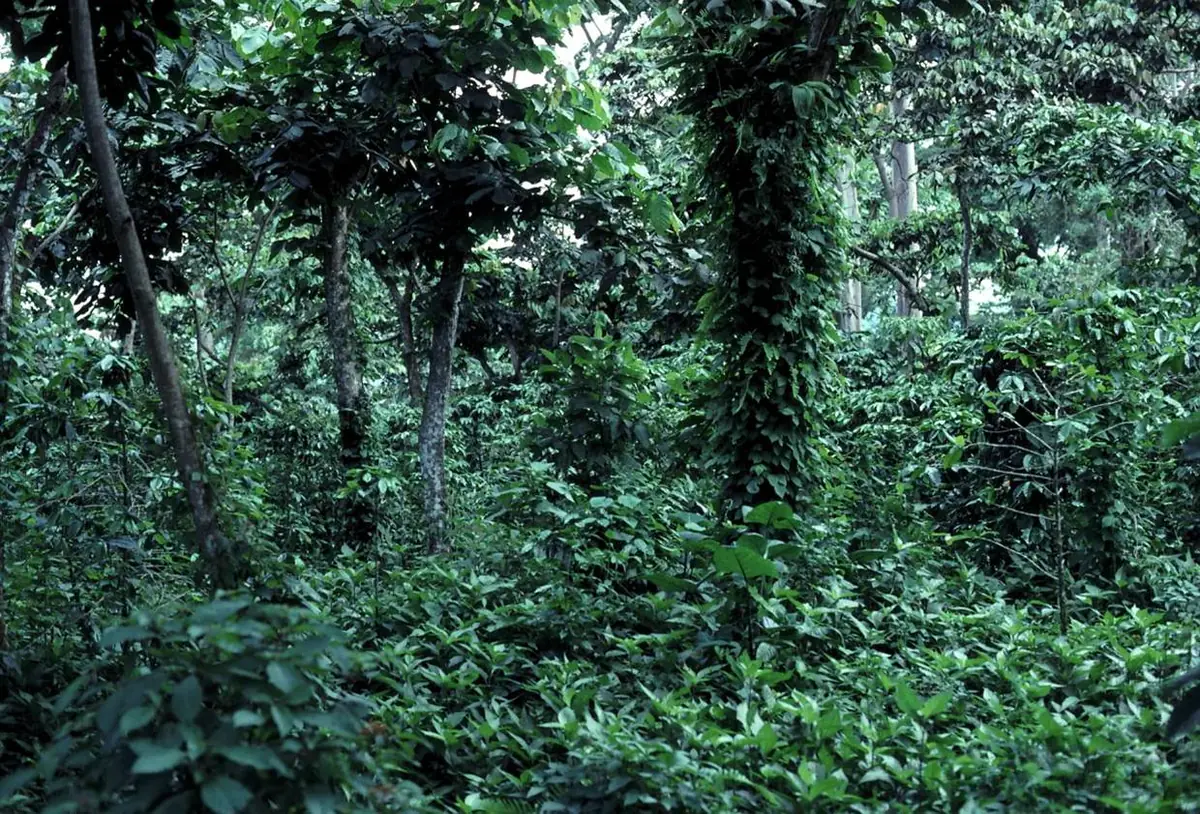
The effect of shade on yield has long been debated in research, with contrasting results depending on the variety [4]. One review indicates that intermediate shade levels (about 35 to 50 %) give the highest yields, with comparisons that are difficult from one region to another [5]. For robusta, shade protects against temperature swings, erosion and radiation, but involves production trade-offs [6]. Agroforestry practices are also studied for managing leaf rust and the coffee berry borer [7].

Harvest
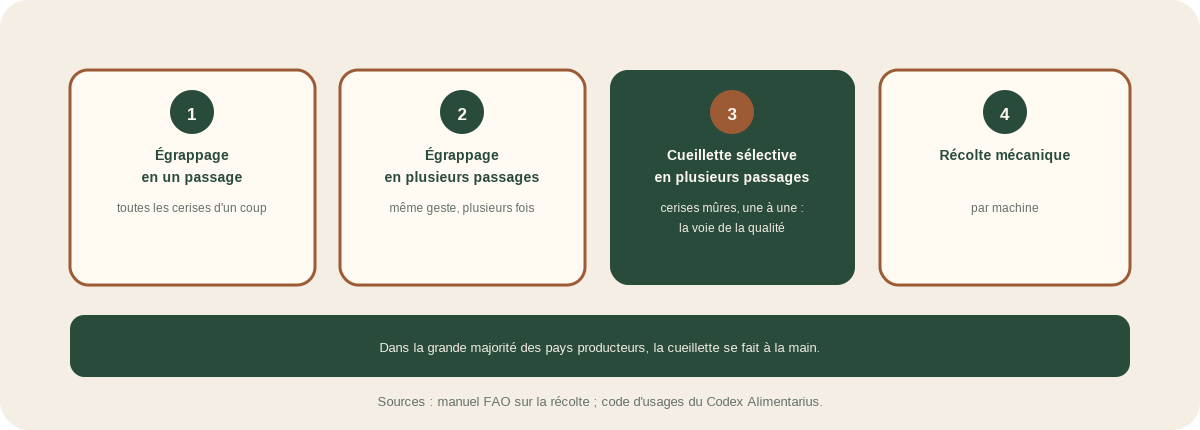
In the great majority of producing countries, coffee is picked by hand; for good quality, cherries must be picked one by one, only when ripe [8]. The Codex code of practice distinguishes four systems: single-pass strip picking, multiple-pass strip picking, multiple-pass selective picking and mechanical harvesting [9].
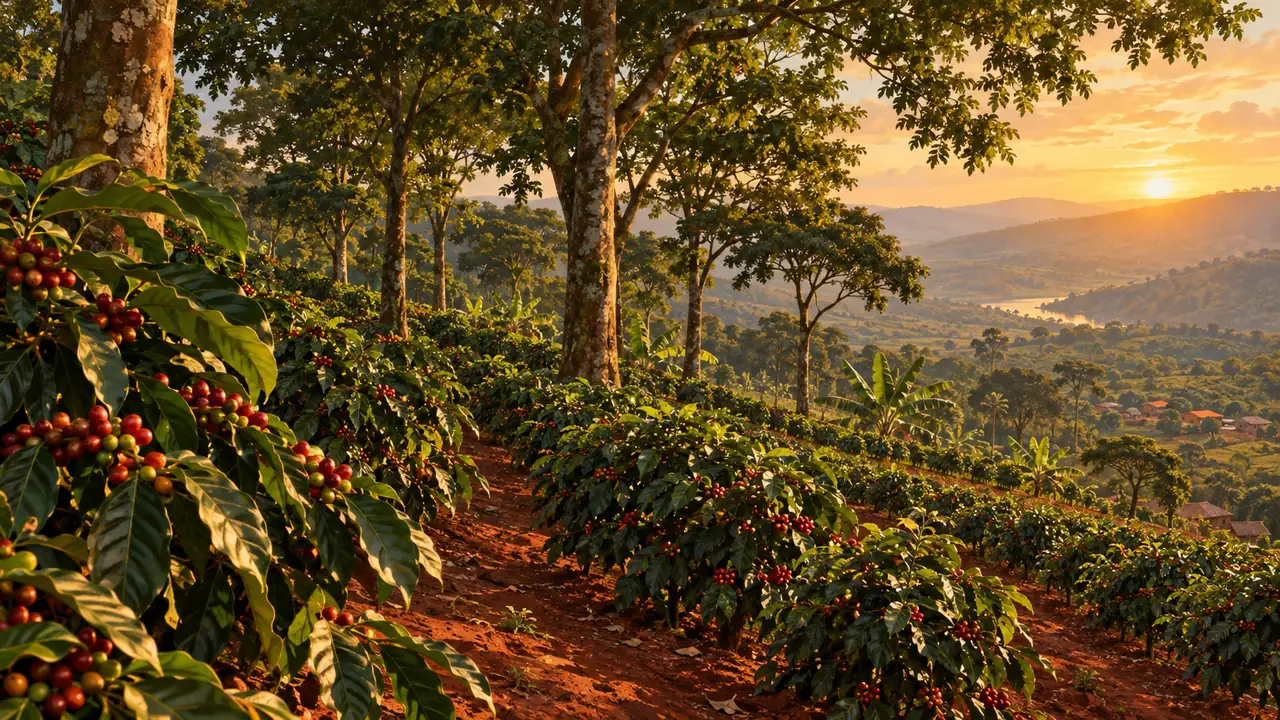
Header image: illustration generated for the site, with editorial value, not a photographic document. The other visuals on the page carry their own credit in the caption.
Dictionary terms (in French)
References
Claims point to the numbered references below, with their access date. Sections marked "to be documented" have no verified source yet and assert nothing. Some sources are secondary: their nature is stated in their title.
- FAO, Coffee: introduction and ecology (X6939E) · accessed 20 November 2026
- Moat et al. (2017), « Resilience potential of the Ethiopian coffee sector under climate change », Nature Plants · accessed 20 November 2026
- BBC News (2017), coverage of the study by Kew and Ethiopian partners on coffee in Ethiopia · accessed 20 November 2026
- Agronomy for Sustainable Development (2022), « Shade effects on yield across different Coffea arabica cultivars » · accessed 20 November 2026
- Jha et al. (2014), A review of production, ecosystem services and farmer livelihoods in shade coffee · accessed 20 November 2026
- Agronomy for Sustainable Development (2020), « Effects of shade trees on robusta coffee growth, yield and quality » · accessed 20 November 2026
- Systematic review: leaf rust and berry borer in agroforestry (Smart Agricultural Technology, 2024) · accessed 20 November 2026
- FAO, Coffee: conclusions and recommendations, harvest quality (X6939E05) · accessed 20 November 2026
- Coffearium, harvesting and sorting cherries (cites the Codex code of practice) · accessed 20 November 2026
Editorial revision: . Dates and data limits remain those given in their sources. Translated from the French chapter.