Extraction and brewing
Brewing coffee means dissolving part of the compounds of the bean. The "Golden Cup" standard gives measurable reference points for filter coffee.
The essentials in three points
Go deeper
Tap a heading to open or close the section.
The Golden Cup standard
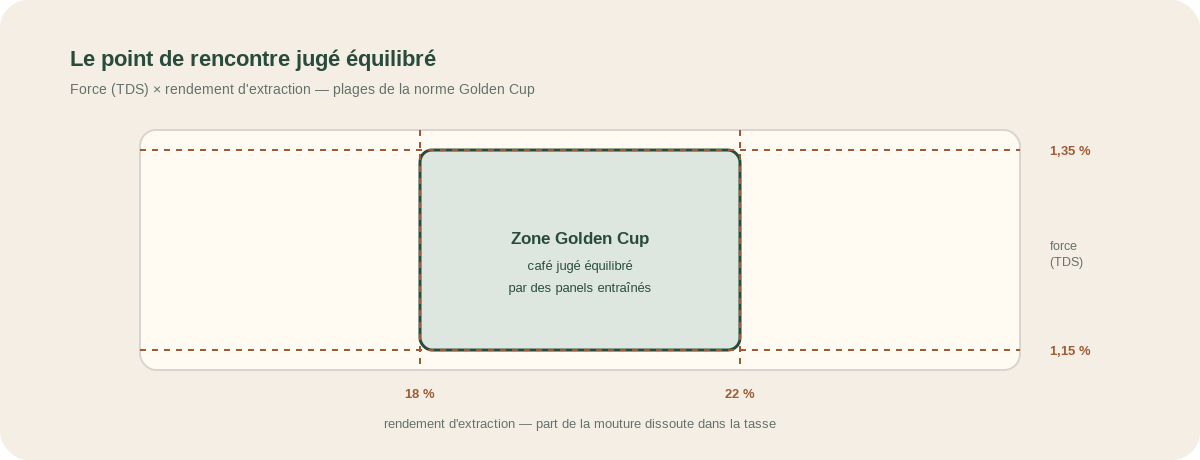
It defines a meeting point between strength (TDS) and extraction yield, at which trained panels and consumers judged the coffee balanced [1]. Strength range: 1.15 to 1.35 %; yield: 18 to 22 % [1] [2].
Water and ratio
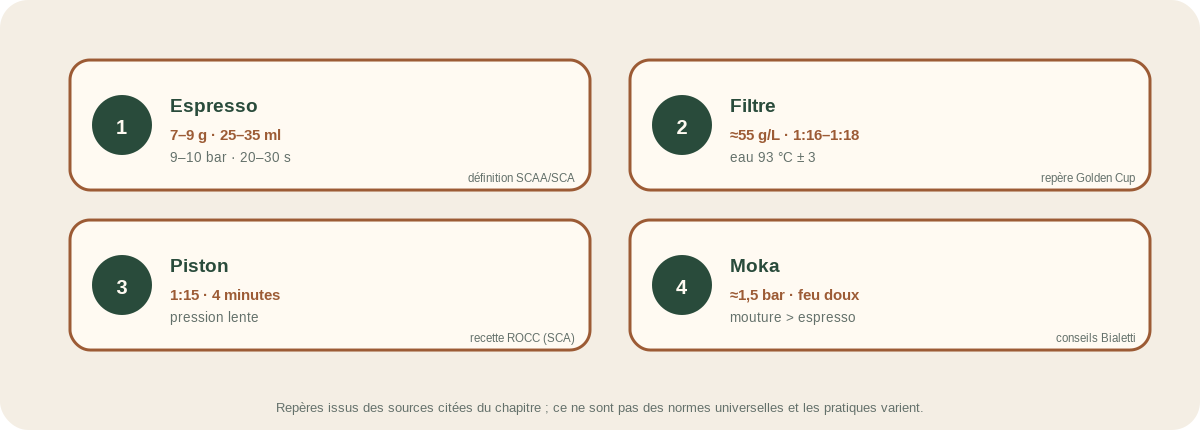
Water temperature: 93 °C ± 3 on contact with the coffee [1]. An SCA training module cites about 55 g of coffee per litre of water, a ratio close to 1:18 [3]. Practical guides also give ratios of 1:16 to 1:17 for filter coffee (secondary source) [4].
Limits of the standard

Grind
The size of the grind affects the speed of extraction, through contact surface, and the speed at which water flows through the coffee bed [3]. Taste diagnosis, espresso, French press and moka pot are detailed in the following sections.
Diagnosing a cup: sour or bitter?
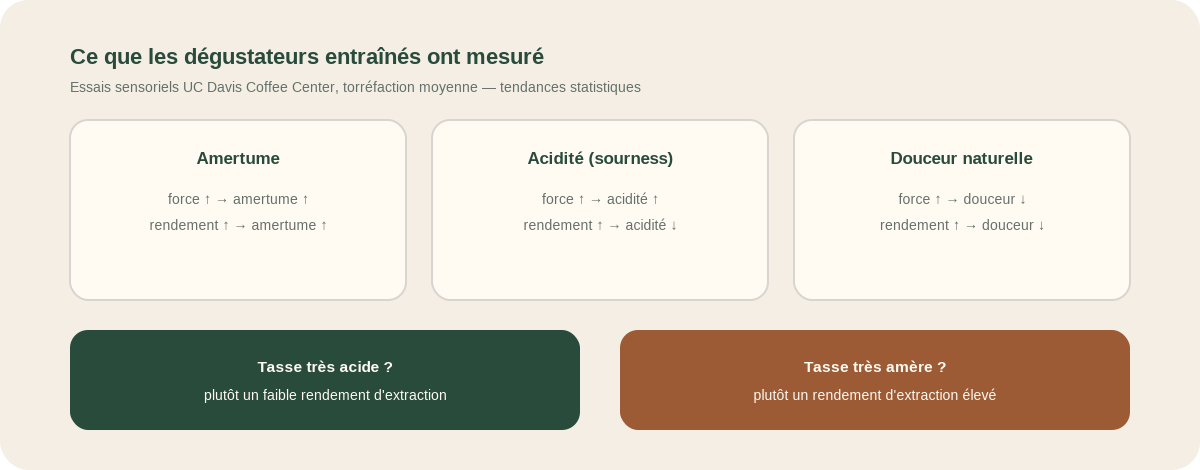
Sensory trials at the UC Davis Coffee Center, with trained tasters, varied the strength (TDS) and the extraction yield (PE) of filter coffee. Results: bitterness increases with strength and with yield (measured on a medium roast); sourness increases with strength but decreases as yield increases; natural sweetness decreases with strength and with yield [8].
Practical reading: a very sour cup points rather to a low yield, a very bitter cup to a high yield. These are statistical trends on controlled samples, not rules for a single cup. The authors note that the classic Lockhart chart (1957) keeps only two attributes, "bitter" and "underdeveloped", and that it mixes taste description with consumer preference [8].
Espresso: reference points and practices
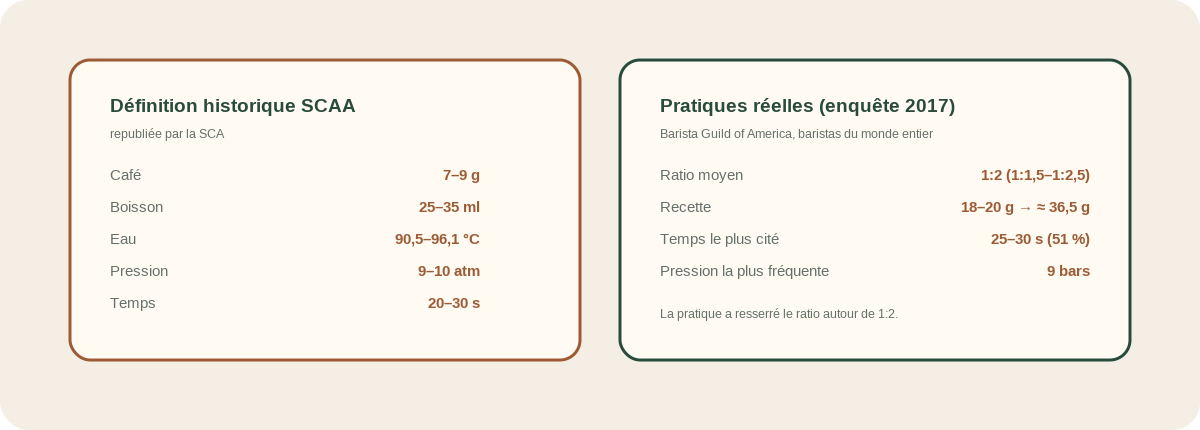
The historical SCAA definition, republished by the SCA, describes an espresso of 25 to 35 ml made with 7 to 9 g of coffee (14 to 18 g for a double), water at 90.5–96.1 °C, a pressure of 9 to 10 atmospheres and a grind such that the extraction time is 20 to 30 seconds [5].
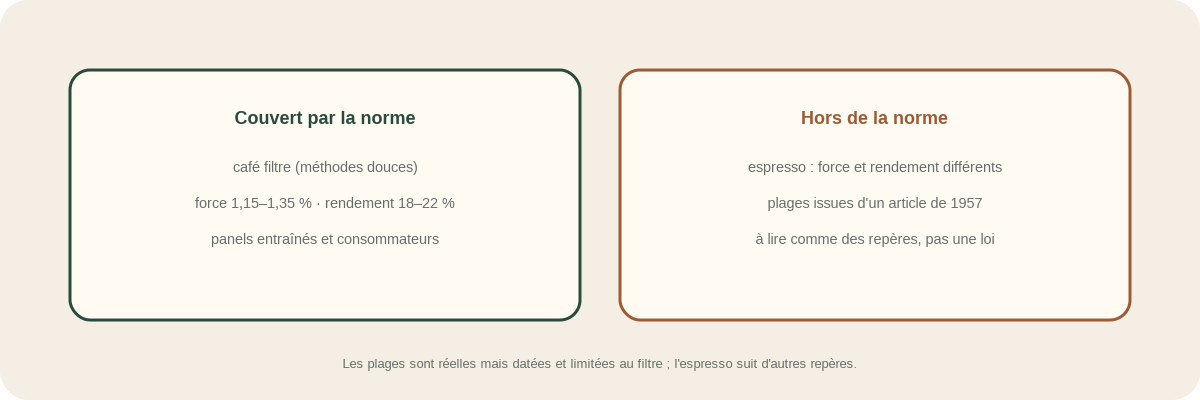
A 2017 survey by the Barista Guild of America of baristas around the world describes real practices: average ratio of 1:2 (from 1:1.5 to 1:2.5), about 36.5 g of drink for 18 to 20 g of coffee, 25 to 30 seconds for 51 % of respondents, 9 bar for the most frequent answer [5]. These are reported practices, not a standard: filter coffee and espresso do not follow the same reference points (see "Limits of the standard").
French press (immersion brewer)
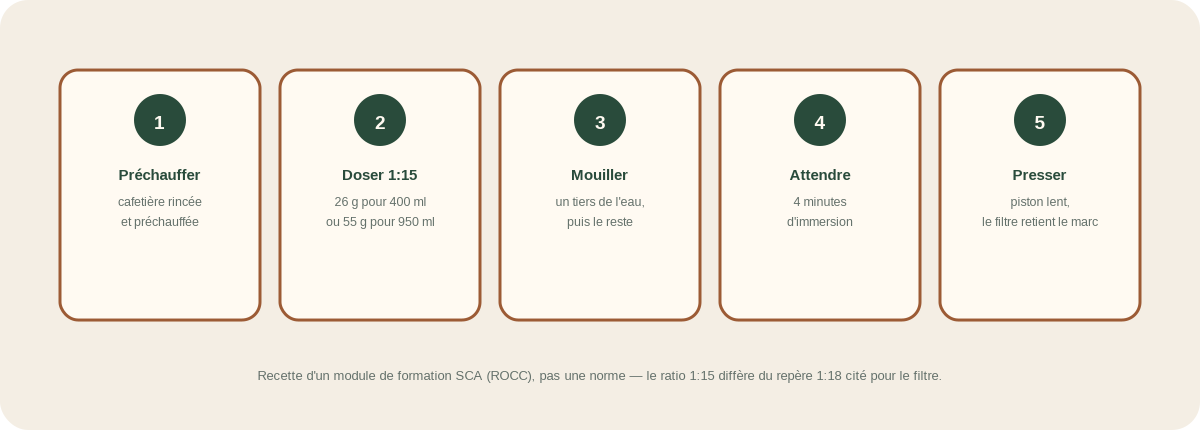
The French press is an extraction by immersion: the coffee and water steep together before the plunger filter holds back the grounds [6]. The ROCC training module (SCA Training) proposes a ratio of 1:15 (for example 26 g of coffee for 400 ml of water, or 55 g for 950 ml), a rinsed and preheated press, one third of the water poured first to wet all the coffee, then the rest, a 4-minute wait and a slow press of the plunger [6]. This is a trainer's recipe, not a standard: the 1:15 ratio differs from the 1:18 reference cited for filter coffee.
Moka pot (Italian stovetop brewer)
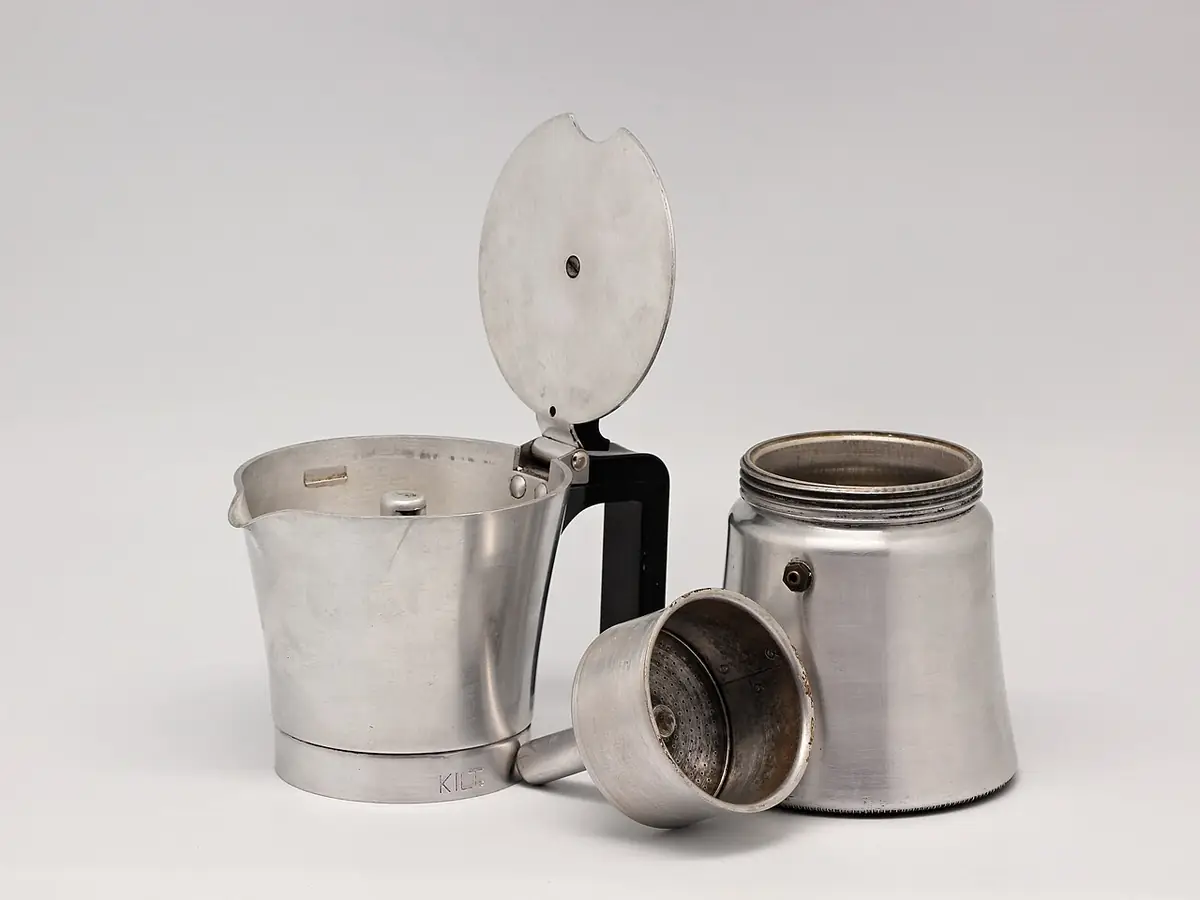
According to Bialetti, the moka pot uses steam pressure: the heated water in the lower chamber is pushed through the coffee and then rises in the column up to the upper collector; the final sputtering signals that the water is almost used up [7]. The manufacturer indicates a pressure of about 1.5 bar, against at least 9 bar for an espresso machine, which explains a different drink [7].
Manufacturer's advice: room-temperature water, rather low in hardness (limescale), a coarser grind than for espresso, low heat [7]. This advice comes from a manufacturer, not from an independent study.

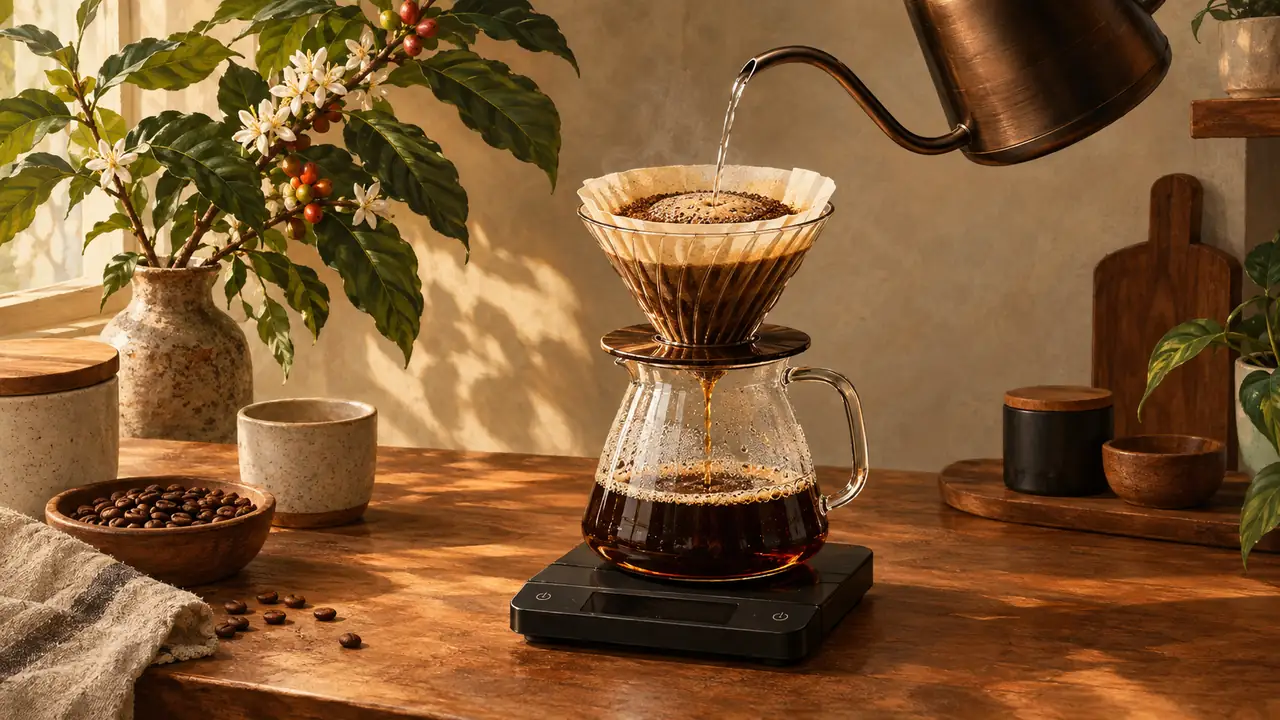
Header image: illustration generated for the site, with editorial value, not a photographic document. The other visuals on the page carry their own credit in the caption.
Dictionary terms (in French)
References
Claims point to the numbered references below, with their access date. Sections marked "to be documented" have no verified source yet and assert nothing. Some sources are secondary: their nature is stated in their title.
- Roastopedia, The Golden Cup Standard (summary of the SCAA/SCA standard) · accessed 20 November 2026
- Beans & Barista, « SCA Golden Cup Standard: what it really says » · accessed 20 November 2026
- SCA Training (ROCC), Brewing Foundation module: Golden Cup, water/coffee ratio · accessed 20 November 2026
- Talk About Coffee, usual ratios by weight (secondary restatement of SCA reference points) · accessed 20 November 2026
- SCA 25 Magazine no. 3 (1 February 2018), D. Fasman, « Defining the Ever-Changing Espresso » (Barista Guild of America 2017 survey) · accessed 20 November 2026
- ROCC (SCA Training), « How to Brew a Great French Press in 10 Easy Steps » (4 November 2020) · accessed 20 November 2026
- Bialetti (manufacturer), « How the Moka works » · accessed 20 November 2026
- SCA 25 Magazine, S. Frost, M. Batali, J.-X. Guinard, W. Ristenpart (UC Davis Coffee Center), « Towards a New Brewing Chart » · accessed 20 November 2026
Editorial revision: . Dates and data limits remain those given in their sources. Translated from the French chapter.