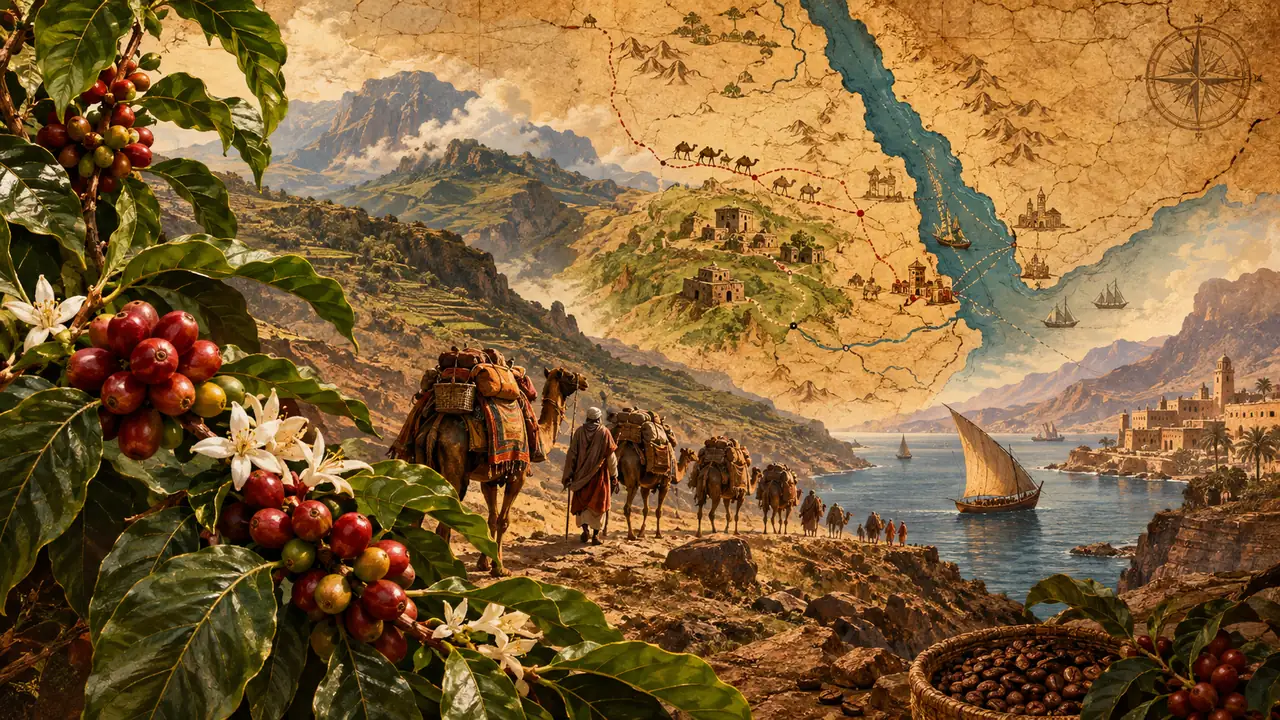
History of coffee
The history of coffee mixes botany, religion, trade, power and colonisation. Legendary stories circulate widely; only documented facts are shown here, with their source.
The essentials in three points
- Arabica is a plant native to the highlands of East Africa, but the drink was born in the Islamic world [1].
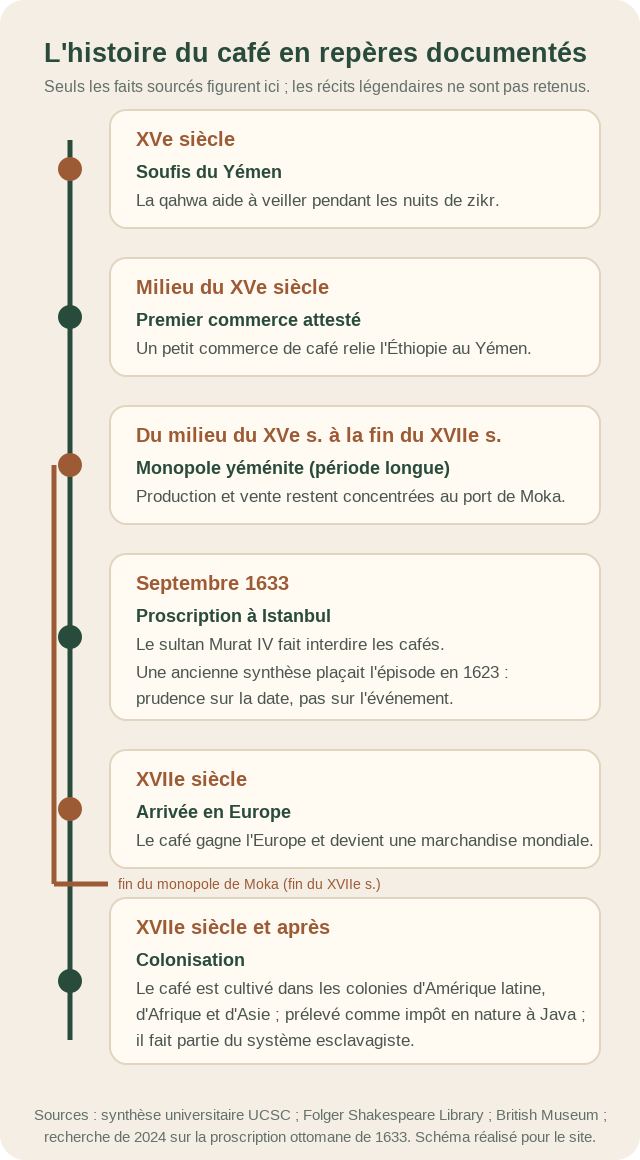
- There is little written evidence before the early 16th century; a small Ethiopia–Yemen coffee trade exists from the mid-15th century [2].
- Coffee remains almost exclusively Islamic until the mid-17th century, then reaches Europe [2].
Go deeper
Tap a heading to open or close the section.
Origins: an African plant, an Islamic drink
The Arabica coffee tree is native to the highlands of East Africa, while the drink has its roots in the Islamic world [1]. The Red Sea region, on the Yemeni and the Ethiopian side, is where coffee appears in the sources [3].
Origin legends exist. They are not sources and are not repeated here as facts.
Yemen and Sufism
In the 15th century, Sufis in Yemen drank qahwa to stay awake during the long nights of dhikr recitation [4]. A small coffee trade between Ethiopia and Yemen is attested from the mid-15th century [2].

Mocha and the Yemeni monopoly
Coffeehouses, power and control
Europe, colonies and slavery
Coffee reaches Europe in the 17th century and becomes a global commodity when Europeans grow it in their colonies in Latin America, Africa and Asia [2]. In the Dutch East Indies, on the island of Java, coffee was taken from peasants as a tax in kind [2]. Coffee was part of the slave system and of colonialism [2]. This history is presented without softening it.
Header image: illustration generated for the site, with editorial value, not a photographic document. The other visuals on the page carry their own credit in the caption.
Dictionary terms (in French)
References
Claims point to the numbered references below, with their access date. Sections marked "to be documented" have no verified source yet and assert nothing. Some sources are secondary: their nature is stated in their title.
- British Museum, "Life in a cup: coffee culture in the Islamic world" (guide) · accessed 20 November 2026
- Coffee, 1400–1800 (University of California, Santa Cruz) · accessed 20 November 2026
- BBC News, "Coffee and qahwa: how a drink for Arab mystics went global" · accessed 20 November 2026
- Folger Shakespeare Library, "Early modern coffee culture and history in the Islamic world" · accessed 20 November 2026
- Ida Beckett, "Power, Piety and Proscription" (Wellesley College, 2024), ban of coffeehouses and tobacco by Murad IV in September 1633 · accessed 20 November 2026
Editorial revision: . Dates and data limits remain those given in their sources. Translated from the French chapter.