
Health and quality
This page presents official reference values, not medical advice. If in doubt (pregnancy, medication, illness), ask a health professional.
The essentials in three points
Go deeper
Tap a heading to open or close the section.
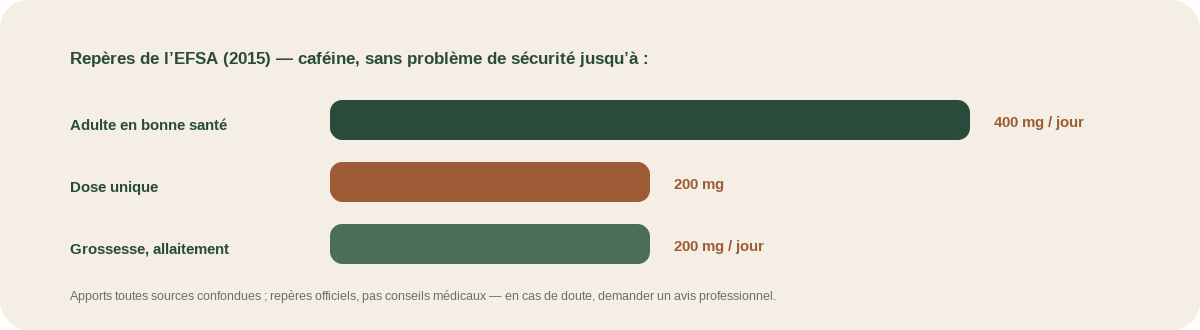
Healthy adults
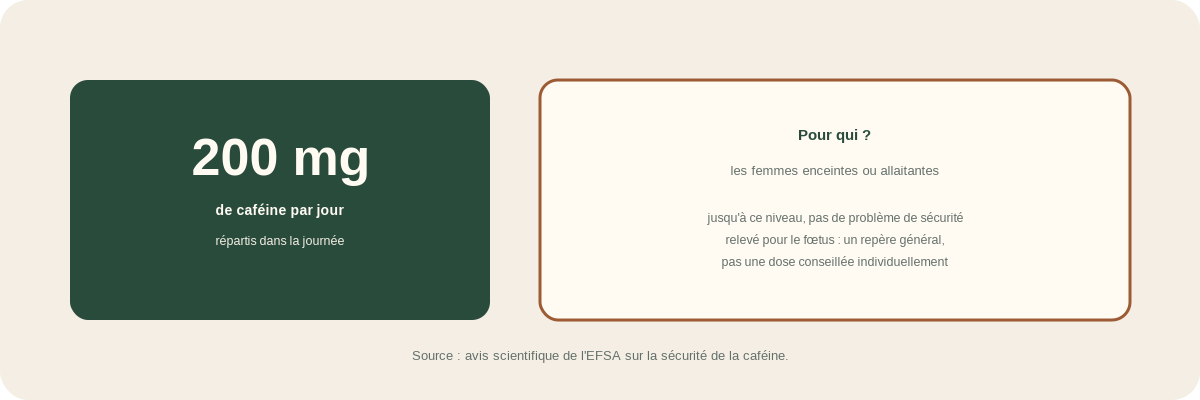
Pregnancy and breastfeeding
Ochratoxin A
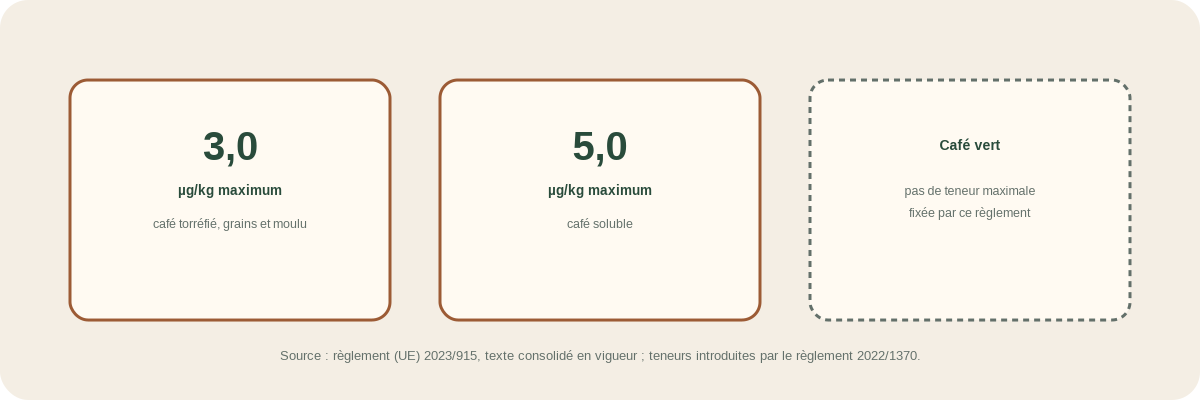
Regulation (EU) 2023/915, consolidated text in force, sets maximum levels of ochratoxin A of 3.0 µg/kg for roasted coffee beans and ground roasted coffee, and 5.0 µg/kg for soluble coffee [3]; these levels were introduced by Regulation 2022/1370 [4]. No maximum level is set for green coffee [3].
Limits of this site
This site makes no health promises and recommends no treatment.
Header image: illustration generated for the site, with editorial value, not a photographic document. The other visuals on the page carry their own credit in the caption.
Dictionary terms (in French)
References
Claims point to the numbered references below, with their access date. Sections marked "to be documented" have no verified source yet and assert nothing. Some sources are secondary: their nature is stated in their title.
- EFSA, "Caffeine" page (scientific opinion of May 2015) · accessed 20 November 2026
- EFSA Journal (2015), Scientific Opinion on the safety of caffeine · accessed 20 November 2026
- Regulation (EU) 2023/915, maximum levels for contaminants, consolidated text (EUR-Lex) · accessed 20 November 2026
- Regulation (EU) 2022/1370, which introduced these levels for coffee (EUR-Lex) · accessed 20 November 2026
Editorial revision: . Dates and data limits remain those given in their sources. Translated from the French chapter.